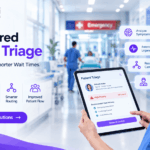
Long waits are one of the most visible problems in hospitals. Crowded emergency departments, short-staffed intake desks, and slow paperwork push patients to wait longer than they should, and sometimes delay care for those who need it most.
AI-powered patient triage offers a practical way to ease this pressure. It gathers patient information quickly, flags urgent cases early, and suggests the right care pathway. It does not replace doctors or nurses. It gives them faster, better-organized information so they can decide sooner.
This guide covers how triage works, where automation helps, the main use cases, the risks, and how hospitals can roll it out safely.
What Is Patient Triage?
Patient triage is the process of deciding how urgent a patient’s condition is and where they should receive care. Trained nurses or physicians assess each person and decide who is seen first, and in which department.
Clinicians usually weigh these inputs:
- Symptoms: what the patient feels and for how long
- Vital signs: heart rate, blood pressure, temperature, oxygen level
- Medical history: past conditions, allergies, current medications
- Age and risk factors: infants, older adults, and pregnant patients often need extra caution
- Presenting condition: the main reason the patient came in
Many hospitals use a structured scale, such as the five-level Emergency Severity Index (ESI), to keep decisions consistent. The outcome sets both the order of care and the place of care: emergency bay, outpatient clinic, specialist, or a virtual visit.
What Is AI-Powered Patient Triage?
AI-powered patient triage uses software to collect patient information, assess urgency, and recommend a care pathway for clinician review. It applies machine learning, language processing, and clinical rules to the same inputs a nurse would consider.
A well-designed system can support:
- Initial assessment through guided questions
- Risk classification into urgency levels
- Patient prioritization within the queue
- Routing to the right department or provider
- Escalation of high-risk cases to a clinician right away
The key point is accountability. The output is decision support, not a diagnosis. Qualified healthcare professionals make the final call and can override any recommendation. This human-in-the-loop approach is central to responsible AI in healthcare.
Why Hospitals Need Healthcare Workflow Automation for Triage
Hospitals need healthcare workflow automation in triage because demand is growing faster than staff capacity. Manual intake cannot keep up with rising patient numbers without causing delays.
Common pressure points include:
- Rising patient volumes and crowded emergency departments
- Manual, inconsistent assessments that vary by nurse, shift, or location
- Limited clinical staff stretched across too many tasks
- Slow data collection, with patients repeating the same details several times
- Inefficient routing, which sends patients to the wrong place first
- Pressure to improve patient experience and operational efficiency
Automation does not remove clinical judgment. It removes the repetitive steps around it, such as data entry, form checking, and queue sorting. That frees nurses to spend more time on patients and less on screens.
How AI-Powered Patient Triage Works
AI-powered patient triage works in five connected steps: collect data, assess risk, prioritize, route, and hand off to a clinician. Each step shortens a different part of the wait.
Patient Data Collection
Patients enter information through kiosks, mobile apps, chatbots, or with help from staff. The system captures symptoms, medical history, current medications, and vital signs from connected devices. This replaces repeated verbal questioning at the front desk.
Data Analysis and Risk Assessment
The system reviews structured data, such as vitals, and unstructured data, such as free-text symptom descriptions. It looks for risk indicators and compares the findings against clinical rules or validated models to estimate urgency.
Patient Prioritization
Patients are grouped by urgency, and potentially critical cases are flagged for immediate attention. The result is a priority suggestion, not a final diagnosis.
Care Routing
Based on the assessment, the system suggests the right pathway: emergency care, outpatient clinic, telehealth, or specialist referral. Fewer patients end up in the wrong queue.
Clinician Review and Escalation
Alerts go to nurses or physicians, who review, update, or override the recommendation. Every action is logged in an audit trail, which supports patient safety and accountability.
How AI in Healthcare Reduces Hospital Wait Times
AI in healthcare reduces wait times by speeding up intake, spotting urgent patients sooner, and keeping patient flow balanced across departments. Delays usually build up between steps, so shortening each handoff has a compounding effect.
Here is where the time is saved:
- Faster information gathering at arrival
- Earlier identification of high-priority patients
- Less repetitive administrative work for staff
- Better routing, so patients reach the right team first
- Workloads balanced across departments
- Smarter appointment and resource scheduling
- Early warning of patient-flow bottlenecks
- Faster escalation when a patient’s condition worsens
- Shorter gaps between assessment and treatment
Together, these changes reduce idle time in waiting rooms and help the most urgent patients get care first.
Key Use Cases of AI Patient Triage
AI patient triage applies wherever patients need to be assessed and directed, not only in emergency rooms. Six use cases stand out.
Emergency Department Triage
The system assesses arriving patients, highlights urgent symptoms, and supports prioritization when the department is busy.
Outpatient and Primary Care Triage
It routes patients to suitable providers and recommends in-person, virtual, or routine care.
Telehealth Triage
Symptoms are collected before a virtual visit. The system flags cases that need a physical exam or emergency care.
Specialty Referral Triage
Referrals are ranked by clinical urgency, and patients are directed to the right specialist.
Pediatric and Geriatric Triage
Age-specific risk checks add extra caution for children and older adults, who can deteriorate quickly.
Post-Discharge Monitoring
Patients report symptoms after leaving the hospital. Warning signs are escalated to the care team, which can help prevent avoidable readmissions.
Benefits of AI-Powered Patient Triage
The main benefit of AI-powered patient triage is faster, more consistent decision support for both patients and staff. The gains show up across the whole care journey.
- Faster patient assessment: less manual data entry and fewer intake delays.
- Better patient flow: patients move more efficiently between departments.
- Improved resource allocation: teams can plan staff, beds, rooms, and equipment with better information.
- Reduced administrative workload: healthcare process automation handles repetitive intake and documentation tasks.
- More consistent triage: the same criteria apply across shifts and locations.
- Better patient experience: patients get clearer direction sooner and feel less uncertain.
- Earlier detection of high-risk cases: concerning patterns reach a professional quickly.
AI Patient Triage vs. Traditional Triage
AI-assisted triage differs from traditional triage mainly in speed, scale, and administrative effort. Clinical responsibility stays with people in both models.
Technologies Behind Predictive Analytics in Healthcare and Triage
Predictive analytics in healthcare sits alongside several other technologies that make AI triage possible. Each one handles a different part of the process.
- Machine learning estimates urgency from patterns in past patient data.
- Natural language processing reads free-text symptoms and notes.
- Conversational AI and chatbots guide patients through intake.
- Predictive analytics forecasts patient surges and flow bottlenecks.
- Computer vision supports image-based assessment where clinically appropriate.
- Electronic health record (EHR) integration pulls in history and writes results back.
- Internet of Medical Things (IoMT) devices stream vital signs.
- Real-time dashboards show queues and capacity.
- Rules-based clinical decision support applies approved protocols.
- APIs and interoperability standards, such as HL7 FHIR, connect separate systems.
Challenges and Risks of AI Triage
The main risks of AI triage are unsafe recommendations, biased results, and weak integration. Hospitals should plan for each before launch.
- Incomplete or inaccurate patient data
- Algorithmic bias across age, gender, or ethnic groups
- False positives and false negatives
- Limited explainability of some models
- Privacy and data security concerns, including HIPAA or local data-protection rules
- Difficult integration with legacy hospital systems
- Gaps in staff training
- Resistance to workflow change
- Overreliance on automated suggestions
- Regulatory and compliance requirements
- Difficulty validating tools across different patient populations
Most of these can be managed with clinical governance, careful testing, and a clear rule that humans keep the final say.
How Hospitals Can Implement Healthcare AI Solutions for Hospitals Successfully
Hospitals succeed with healthcare AI solutions when they start small, involve clinicians early, and measure results. A phased rollout lowers risk and builds trust.
- Define the Use Case : Pick one workflow first, such as emergency intake or outpatient routing.
- Establish Clinical Governance : Bring together physicians, nurses, administrators, compliance teams, and IT leaders.
- Use High-Quality Data : Make sure data is accurate, representative, secure, and well documented.
- Keep Clinicians in the Loop : Let professionals review, override, and give feedback on every recommendation.
- Integrate with Existing Systems : Connect the tool to EHRs, scheduling platforms, patient portals, and hospital management systems.
- Test Before Scaling : Run a pilot and evaluate accuracy, safety, wait times, workload, and patient outcomes.
- Monitor and Improve Continuously : Review performance across patient groups and update the system when needed.
Metrics to Measure AI Triage Performance
The best way to measure AI triage is to track both speed and safety. Choose a baseline before launch so improvements are provable.
- Average patient wait time
- Time from arrival to initial assessment
- Time from assessment to treatment
- Patient throughput and length of stay
- Triage accuracy and escalation accuracy
- False-positive and false-negative rates
- Staff workload and number of manual interventions
- Patient satisfaction
- Clinical outcomes
The Future of AI-Powered Patient Triage
AI-powered patient triage is moving from simple intake support toward predictive, connected hospital operations. Several trends are already taking shape:
- Predictive patient-flow management
- Real-time hospital capacity monitoring
- Personalized care-pathway recommendations
- Integration with wearable devices
- Voice-based patient intake
- AI-supported remote monitoring
- Digital twins for hospital operations
- A stronger focus on explainability, safety, and responsible AI
Conclusion
AI-powered patient triage can help hospitals speed up intake, prioritize urgent cases, improve routing, and manage patient flow. Used well, it cuts wait times and reduces the administrative load on staff.
Its value depends on good practice: high-quality data, clinical governance, strong interoperability, continuous monitoring, and above all human oversight. AI should support clinical judgment, never replace it.
If your hospital is exploring healthcare AI and workflow automation, start with one focused pilot and build from there. Kriatix AI builds custom AI and automation solutions for healthcare teams, from triage workflows to EHR integration.
Ready to Transform Healthcare with AI?
Explore how Kriatix AI can help healthcare organizations implement intelligent,
scalable AI solutions for faster and more efficient care workflows.