Healthcare systems and insurers are entering 2026 under intense financial and operational pressure. Rising chronic disease prevalence, increasing claims ratios, workforce health challenges, and regulatory complexity are forcing enterprises to shift from reactive treatment models to preventive, data-driven engagement.
At the center of this transformation is healthcare ai not as an experimental innovation, but as an operational backbone. Diet and wellness automation platforms powered by healthcare ai are enabling proactive, personalized member engagement at enterprise scale.
This guide explores the best diet & wellness automation platforms for healthcare enterprises in 2026, with a focus on business outcomes, ROI, governance, and scalable AI integration.
Why Diet & Wellness Automation Is a Strategic Imperative in 2026
Healthcare enterprises are increasingly investing in ai in health care to address preventable conditions such as diabetes, cardiovascular disease, obesity, and hypertension. These lifestyle-driven health risks account for a disproportionate share of claims expenditure.
Traditional outreach mass email campaigns or manual care coordination lacks personalization and scalability. In contrast, platforms powered by healthcare ai enable:
- Real-time behavioral nudges
- Personalized nutrition guidance
- Risk-based health messaging
- Automated adherence reminders
- Data-driven preventive care campaigns
As part of broader ai and healthcare transformation strategies, diet and wellness automation platforms are helping organizations reduce downstream costs while improving member satisfaction.
What Defines the Best Diet & Wellness Automation Platforms?
Enterprise CIOs and digital transformation leaders must evaluate platforms through a strategic lens not feature checklists alone.
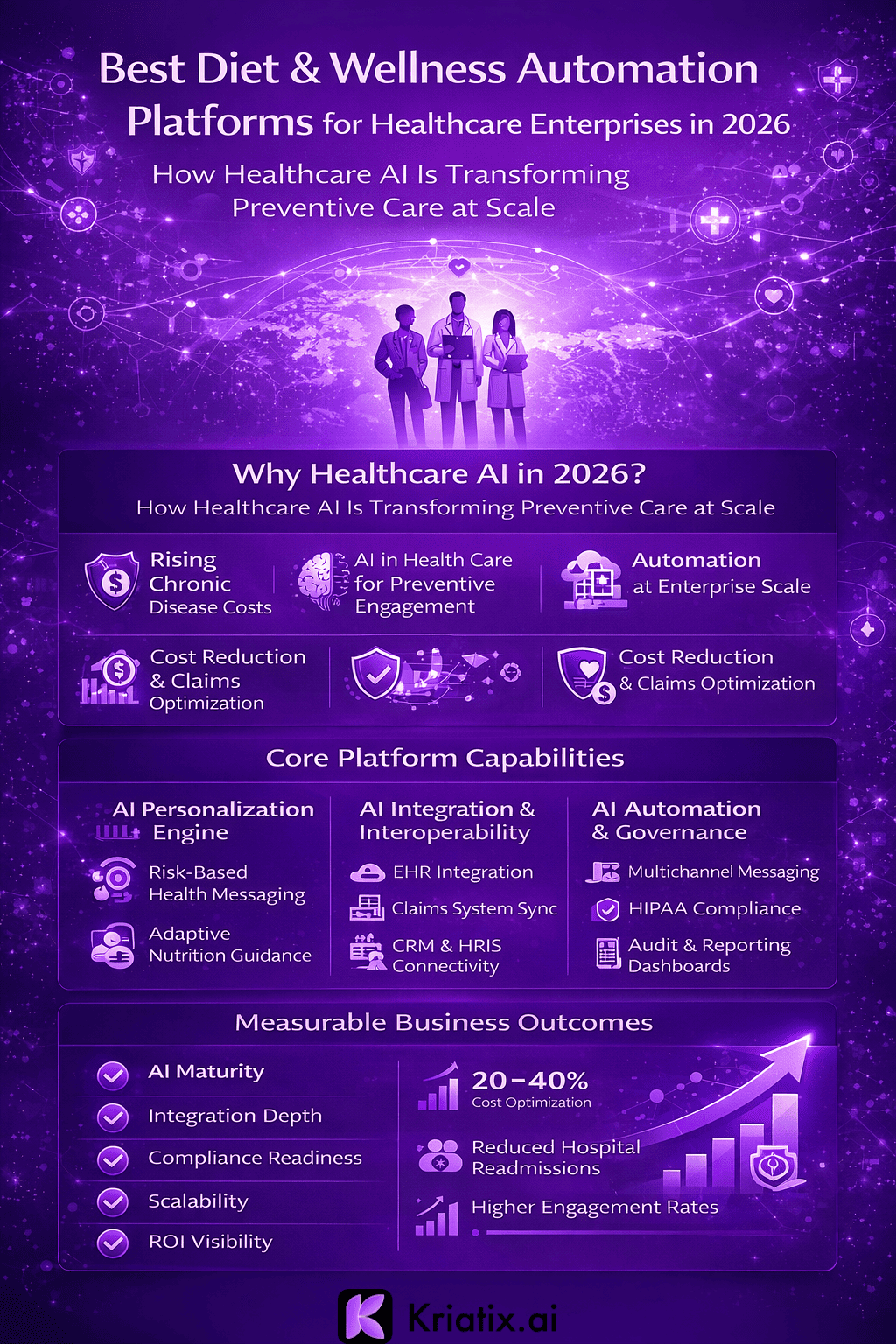
1. AI-Driven Personalization at Scale
The most advanced platforms use healthcare ai models trained on:
- Claims history
- Risk stratification data
- Electronic Health Records (EHR)
- Demographic and lifestyle indicators
- Wearable device inputs
Through intelligent decision engines, these platforms deliver hyper-personalized dietary and wellness recommendations. For example:
- Low-sodium guidance for hypertensive patients
- Nutritional coaching for pre-diabetic members
- Weight management nudges for high-risk policyholders
Unlike rule-based messaging systems, modern health ai platforms adapt content based on engagement patterns and behavioral signals.
Business Outcome: Higher engagement rates and improved chronic disease management.
2. Seamless AI Integration with Enterprise Systems
No platform can operate in isolation. Effective ai integration ensures interoperability with:
- EHR systems
- Claims management platforms
- CRM and member portals
- Population health analytics tools
- Employer HRIS systems
The best diet & wellness automation platforms provide API-first architectures and compliance-ready frameworks that allow secure ai integration into existing enterprise IT stacks.
This reduces manual workflows and ensures that wellness messaging is triggered automatically by real-time health data.
3. Governance, Compliance, and Risk Management
Healthcare operates under strict regulatory environments.
Platforms leveraging ai in health care must support:
- HIPAA-compliant data encryption
- Audit trails and governance logs
- Role-based access control
- AI explainability features
- Bias detection mechanisms
Governance maturity is essential to scaling ai automation across large healthcare enterprises without introducing compliance risk.
For CIOs, security architecture often determines whether a pilot program can scale enterprise-wide.
4. Automation at Enterprise Scale
The defining feature of leading platforms is their ability to support millions of interactions daily through advanced ai automation engines.
Core capabilities include:
- Multichannel delivery (SMS, app push, email, WhatsApp)
- Workflow orchestration tools
- Automated campaign lifecycle management
- Predictive engagement scoring
- Intelligent content personalization
Scalable healthcare ai systems allow operations teams to manage preventive care initiatives without increasing administrative headcount.
5. Embedded Analytics and ROI Measurement
Enterprise leaders require measurable outcomes.
The best diet & wellness automation platforms provide dashboards that track:
- Engagement rates
- Health behavior improvements
- Claims cost reduction
- Readmission rate changes
- Member retention improvements
By connecting wellness engagement metrics to financial KPIs, platforms powered by healthcare ai demonstrate tangible business impact.
Key Enterprise Use Cases in 2026
Chronic Disease Management Programs
Healthcare providers and insurers use ai in health care platforms to deliver structured dietary guidance for chronic conditions.
Automated reminders, adaptive meal plans, and personalized lifestyle nudges improve medication adherence and reduce complications.
Long-term data indicates that preventive engagement reduces high-cost claims categories.
Employer-Sponsored Wellness Programs
Large enterprises are embedding health ai solutions into workforce wellness strategies.
HR and operations leaders use automated wellness messaging to:
- Improve productivity
- Reduce absenteeism
- Lower employer-sponsored health plan costs
- Enhance employee engagement
AI-driven diet and fitness prompts have measurable impact on workforce health KPIs.
Population Health Campaigns
Public health systems deploy ai and healthcare platforms for preventive outreach at scale.
Campaigns targeting nutrition awareness, diabetes prevention, and cardiovascular health can be executed across millions of members simultaneously through automated messaging systems.
Value-Based Care Optimization
Under value-based reimbursement models, preventive care directly influences provider revenue.
Advanced ai automation platforms support:
- Post-discharge dietary guidance
- Risk-based patient outreach
- Preventive screening reminders
- Continuous health behavior monitoring
This aligns operational efficiency with reimbursement incentives.
Build vs Buy: A Strategic Consideration
Healthcare CIOs must evaluate whether to build internal wellness messaging tools or adopt specialized platforms.
Building In-House
Advantages:
- Custom architecture
- Internal control over models
Challenges:
- Long development cycles
- High compliance overhead
- Ongoing AI model training complexity
- Security and governance burden
Buying a Commercial Platform
Advantages:
- Rapid deployment
- Pre-built compliance frameworks
- Proven ai integration capabilities
- Continuous vendor innovation
For most healthcare enterprises, commercial platforms offer faster ROI and reduced regulatory risk.
Emerging Trends in Healthcare AI for Wellness Automation
Agentic AI and Adaptive Engagement
Modern healthcare ai systems are transitioning toward agentic AI models that:
- Learn from individual behavior patterns
- Adjust communication frequency dynamically
- Predict disengagement risks
- Recommend escalation to care teams
This marks a shift from static notifications to intelligent digital health agents.
Hyper-Personalized Nutrition Intelligence
AI-driven dietary analysis tools now integrate nutritional science databases, cultural preferences, and biometric inputs to generate highly personalized wellness plans.
This evolution reflects broader innovation in ai and healthcare ecosystems.
Predictive Risk Scoring
Advanced predictive models use ai in health care analytics to identify members at high risk for chronic disease progression triggering early wellness interventions.
Proactive outreach lowers claims exposure and improves long-term health outcomes.
Financial Impact: Cost Reduction Through Preventive AI
Healthcare cost inflation remains a major concern for insurers and self-insured employers.
Preventive engagement powered by healthcare ai supports:
- Reduced emergency room visits
- Lower hospitalization rates
- Improved medication adherence
- Reduced lifestyle-related claim spikes
Finance leaders increasingly view diet and wellness automation as a cost-containment lever, not merely an engagement tool.
Executive Evaluation Checklist
When assessing the best diet & wellness automation platforms, leadership should evaluate:
-
AI personalization maturity
-
Depth of ai integration with existing IT systems
-
Compliance and governance readiness
-
Scalability across member populations
-
Embedded ROI measurement frameworks
-
Five-year total cost of ownership
Platforms that align with enterprise strategy will deliver sustainable value beyond initial deployment.
Conclusion
The best diet & wellness automation platforms for healthcare enterprises in 2026 are those that combine scalable healthcare ai, seamless system integration, compliance maturity, and measurable business outcomes.
As preventive care becomes central to healthcare economics, enterprises that invest strategically in ai automation will gain competitive advantage through lower claims exposure, improved productivity, and stronger member engagement.
Healthcare AI is no longer experimental it is operational infrastructure.
Ready to Deploy Healthcare AI for Preventive Engagement?