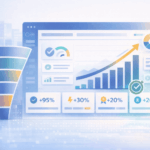
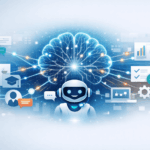
Introduction: The Shift Toward Intelligent Workflows
Enterprises today aren’t simply adopting AI tools they’re redesigning their entire operating system around intelligent, automated workflows. This shift is not just a productivity upgrade; it’s a structural transformation driven by AI’s ability to understand data, make decisions, automate actions, and continuously improve.
And the center of this transformation is the rise of AI workflow models.
These models allow teams to automate repetitive work, streamline decision-making, and scale operations without expanding headcount.
At the heart of this evolution sits a modern AI automation platform like Kriatix, built to help enterprises design and run intelligent workflows end-to-end.
What AI Workflow Models Really Mean for Enterprises
AI workflow models combine automation, analytics, reasoning, and predictive intelligence into a single flow. Instead of depending on manual processes, employees jump straight to high-value work while AI handles the heavy lifting.
These models typically include:
- Real-time data processing
- Automated decision pathways
- Predictions and recommendations
- Document and multimodal analysis
- Human checkpoints where needed
- Self-learning optimization
This approach delivers what every enterprise wants: speed, accuracy, and scalability without burdening teams with repetitive tasks.
The Trending AI Workflow Models Transforming Productivity
1. Unified AI Workflow Automation Models
These workflows are built to run an entire process end-to-end not just one task.
For example:
- Lead qualification → nurturing → conversion
- Hiring → onboarding → training
- Procurement → compliance → vendor payout
A unified model gives enterprises a way to operate from one command center rather than juggling multiple disjointed tools.
A modern AI automation platform like Kriatix strengthens this by combining data, logic, and automation into a cohesive system any team can scale globally.
2. Autonomous Decision-Making Workflows
This is where automation moves from “doing tasks” to “making smart decisions.”
Autonomous workflows use:
- Predictive modelling
- GenAI reasoning
- Rules + AI blended logic
- Risk scoring
- Automated recommendations
Example:
A logistics workflow that predicts delivery delays and reroutes shipments automatically.
This is trending because enterprises want fewer bottlenecks and more real-time, intelligent decisions that don’t require human intervention every step of the way.
3. Multimodal AI Workflows (Voice, Text, Image, Video)
Work no longer comes in a single format. Enterprises deal with:
- Handwritten notes
- Voice memos
- Scanned receipts
- Complex charts
- Contract PDFs
- Screenshots from field teams
Multimodal workflows can analyze any of these inputs and convert them into insights and actions instantly.
This allows scenarios like:
- Uploading a contract → AI extracts risk areas → sends insights for approval
- Uploading a machine image → AI detects faults → triggers a repair workflow
This model is rising quickly because enterprises want automation that mirrors how real work actually flows.
4. Employee Productivity Workflows Powered by AI
These workflows function like personal AI assistants embedded into daily tasks.
Examples include:
- Automated report creation
- AI-driven email drafting
- Meeting summaries with action points
- Voice-to-action task creation
- Research automation
These workflows accelerate output and create consistent productivity across distributed teams.
Platforms like Kriatix tap into this by enabling employees to handle complex work faster through built-in generative and summarization capabilities.
5. Predictive and Preventive AI Workflow Models
Enterprises are moving from reactive to proactive operations.
Predictive workflows do things like:
- Forecast customer churn
- Predict system failures
- Spot financial anomalies
- Forecast inventory needs
- Prevent SLA breaches
The preventive layer ensures that a predicted issue is resolved automatically before it becomes a problem.
This unlocks huge cost savings and boosts reliability across operations.
6. Cross-Departmental AI Workflow Models
These workflows remove silos and create shared systems that operate across:
- Sales
- Marketing
- Finance
- HR
- Support
- Operations
- Tech
Examples:
- Sales forecast automatically triggering hiring workflows
- Customer insights driving marketing personalization flows
- Compliance checks embedded across multiple departments
This trend is accelerating because enterprises want integrated operations not fragmented tools.
7. Human-in-the-Loop (HITL) AI Workflows
These workflows blend automation with human judgment.
AI handles:
- Data extraction
- Risk scoring
- Summaries
- Decision suggestions
Humans intervene only when necessary:
- Approvals
- Exception handling
- Sensitive decisions
- Policy validations
HITL is becoming essential for industries like finance, healthcare, and global enterprises where compliance and oversight matter.
8. Intelligent Document Processing (IDP) Workflows
IDP workflows automate everything around document-heavy operations.
They handle:
- Classification
- Extraction
- Cross-field validation
- Sentiment and clause detection
- Summary generation
Auto-routing to stakeholders
This is transforming functions such as finance, legal, procurement, and HR.
With the right AI automation platform, enterprises can process thousands of documents daily without manual effort.
9. Industry-Specific AI Workflow Models
These workflows are tuned for real-world sector needs.
Retail
- Personalized recommendations
- Inventory forecasting
- Loss prevention automation
BFSI
- Fraud detection
- Credit risk workflows
- KYC/AML document automation
Manufacturing
- Predictive maintenance
- Defect detection
- Inventory optimization
Healthcare
- Patient engagement workflows
- Claims automation
- Clinical record processing
HR
- Automated screening
- Skill-gap assessment workflows
- Performance scoring
Industry-specific automation is trending because enterprises want AI that solves their exact operational problems not generic automation.
How Kriatix Leads the New Era of AI Workflow Automation
Kriatix stands apart because it is built as an AI automation platform from the ground up not an add-on, not a stitched-together tool, but a unified engine for enterprise workflow transformation.
Here’s what makes it powerful.
1. An AI-Native Workflow Engine
Kriatix enables:
- AI-based decisions
- GenAI reasoning
- Predictive actions
- Multimodal processing
Autonomous workflow optimization
This creates workflows that think, learn, and act.
2. Visual, No-Code Workflow Builder
Teams can build complex workflows using a drag-and-drop builder, allowing:
- HR
- Finance
- Operations
- Support
- Sales
- IT
to automate work without relying on deep engineering teams.
3. Multimodal Automation Built-In
Kriatix handles:
- Text
- Voice
- Images
- PDFs
- Data files
- Dashboards
This gives teams a single place to automate any real-world input.
4. AI Copilot for Every Employee
Whether someone is drafting documents, analyzing data, clarifying requirements, or summarizing information, the copilot accelerates work dramatically.
5. Enterprise-Grade Controls & Governance
Kriatix provides:
- Role-based access
- Secure pipelines
- Audit logs
- Policy triggers
- Enforced compliance workflows
Perfect for enterprises that cannot compromise on security.
What the Future Looks Like
AI workflow automation is on track to become a core enterprise capability the same way CRMs and ERPs became standard in the past decade.
The companies that adopt AI workflow models now will:
- Cut operational time significantly
- Increase accuracy and consistency
- Reduce manual effort
- Improve decision-making
- Scale faster
- Innovate continuously
And platforms like Kriatix are the engines powering this shift.
Ready to transform your enterprise with intelligent workflows?
Conclusion
AI workflow models are now central to how modern enterprises operate. They cut manual effort, speed up decisions, and bring consistency across every function. Companies that adopt these intelligent workflows gain a clear productivity advantage faster operations, sharper insights, and smarter execution. With an AI automation platform like Kriatix enabling this shift, teams can build and scale automation effortlessly. The future of enterprise productivity is intelligent, automated, and already within reach.