Agentic AI use cases are no longer confined to research labs in 2026, they are running live inside hospitals, banks, factories, and customer service desks. An agentic AI system doesn’t just answer a question; it plans a sequence of steps, takes action across multiple tools, and adapts when something goes wrong, all with minimal human supervision. Gartner projects that 40% of enterprise applications will embed task-specific AI agents by the end of 2026, up from under 5% in 2025 a sign of how fast this shift is moving from pilot projects to production systems. This guide walks through 15 real, industry-specific agentic AI use cases, what they cost, where they fail, and how to pick the right one for your business.
What Are Agentic AI Use Cases? Definition, Examples, and How They Work
Agentic AI use cases are applications where an AI system independently plans, executes, and adjusts multi-step tasks to reach a goal, rather than just generating a single response. Instead of a person prompting an AI for each step, the agent breaks a goal into sub-tasks, calls APIs or tools, checks its own output, and corrects course — for example, an agent tasked with “resolve this customer’s billing dispute” will pull account data, verify policy, issue a refund, and send a confirmation, all without a human typing each instruction.
What makes these use cases distinct is autonomy combined with accountability: agentic systems operate inside guardrails (approval limits, audit logs, escalation rules) so businesses retain control even as the agent acts independently. This is why agentic AI use cases are showing up first in workflows with clear rules and measurable outcomes fraud checks, ticket resolution, inventory replenishment rather than open-ended creative work.
Agentic AI vs Generative AI: What’s the Real Difference?
Generative AI creates content text, images, code in response to a single prompt, while agentic AI plans and executes a chain of actions toward a goal across multiple steps and tools. Generative AI is reactive; you ask, it answers. Agentic AI is proactive; you set an objective, and it figures out the “how.”
In practice, most production agentic AI use cases are built on top of generative AI models a large language model still does the reasoning and language generation, but it’s wrapped in an orchestration layer that gives it memory, tool access, and the ability to take multiple turns without a human in between each one. This is also why multi-agent systems are emerging as the dominant 2026 pattern: instead of one agent doing everything, specialized agents (a research agent, a verification agent, an execution agent) hand off work to each other, similar to how a human team divides labor.
Why Are Enterprises Investing in Agentic AI Use Cases in 2026?
Enterprises are investing in agentic AI use cases in 2026 because the technology has crossed a reliability threshold that makes autonomous, multi-step execution commercially viable rather than experimental. Error rates in multi-step agent reasoning dropped sharply through late 2025, and the global AI agents market is now projected to reach roughly $10.9–12 billion in 2026, growing at over 40% annually a pace few enterprise software categories have matched.
The business case is straightforward: agentic AI use cases target the expensive, repetitive, multi-step work that previously required either a human or a chain of separate automation tools. A loan underwriting agent, for instance, doesn’t just flag a missing document it requests it, validates it, and resubmits the file. That collapses a workflow that used to involve three handoffs into one continuous, monitored process. The catch, and the reason adoption outpaces production-readiness, is governance: Gartner expects more than 40% of agentic AI projects to be cancelled by 2027 due to unclear ROI or weak oversight which is exactly why a structured, audited rollout matters more than speed.
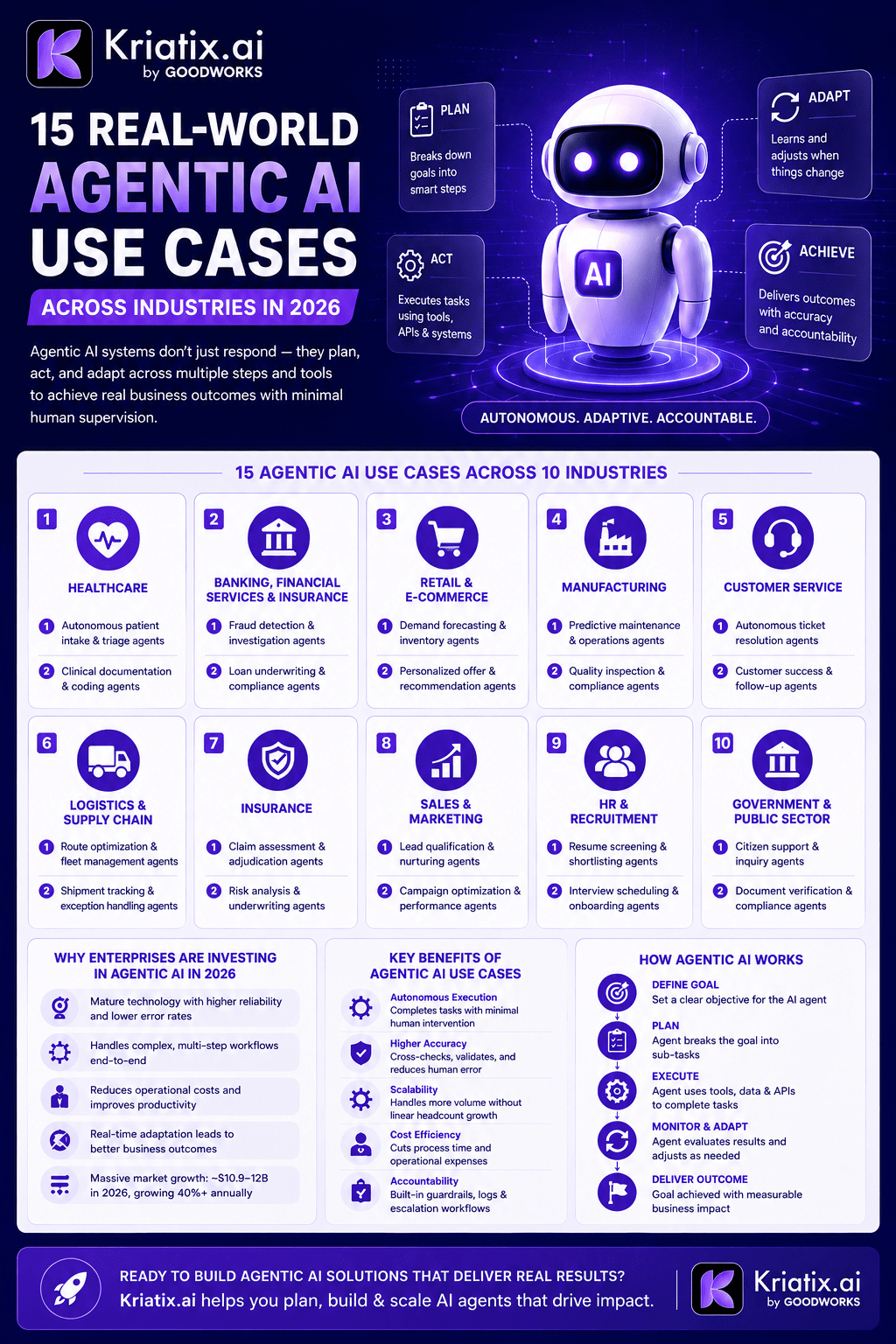
15 Real-World Agentic AI Use Cases Across Industries in 2026
Below are 15 agentic AI use cases currently in production or active pilot across ten industries, grouped so you can find the ones closest to your own operations.
Agentic AI Use Cases in Healthcare
Healthcare is deploying agentic AI for both administrative and clinical-support workflows, where multi-step accuracy directly affects patient outcomes and compliance.
- Autonomous patient intake and triage agents these agents collect symptoms through conversational intake, cross-reference history, prioritize urgent cases, and route patients to the right specialist or queue, reducing front-desk bottlenecks.
- Clinical documentation and coding agents they listen to (or read) consultation notes, generate structured clinical documentation, assign billing codes, and flag inconsistencies for physician review before claims submission, cutting documentation time significantly.
Agentic AI Use Cases in Banking, Financial Services, and Insurance (BFSI)
BFSI is one of the earliest and most mature adopters of agentic AI use cases because its workflows are rule-bound, auditable, and high-volume.
- Autonomous fraud detection and investigation agents beyond flagging a suspicious transaction, these agents pull related account history, cross-check device and location signals, open a case file, and escalate only the confirmed-risk cases to a human analyst.
- Loan underwriting and compliance agents these agents verify documents, run credit and risk checks across multiple data sources, request missing information directly from applicants, and pre-fill compliance reports, shrinking underwriting cycles from days to hours.
Agentic AI Use Cases in Retail and E-Commerce
Retailers use agentic AI to manage the constant churn of inventory, pricing, and personalization decisions that no static rules engine can keep up with.
- Autonomous demand forecasting and inventory agents these agents monitor sales velocity, seasonality, and supplier lead times, then automatically trigger reorders or reallocate stock between warehouses before a stockout happens.
- Personalized shopping and post-purchase agents they track browsing and purchase behavior, proactively recommend restocks or complementary products, and handle returns or exchanges end-to-end without escalation.
Agentic AI Use Cases in Manufacturing and Industrial Operations
Manufacturing’s agentic AI use cases focus on uptime and supply continuity, where a missed signal can halt an entire production line.
- Predictive maintenance agents these agents continuously analyze sensor data from machinery, predict failure windows, automatically schedule maintenance slots, and order replacement parts ahead of breakdown.
- Supply chain orchestration agents they monitor supplier performance, shipping delays, and raw material pricing in real time, then re-route orders or renegotiate delivery windows autonomously to avoid production stalls.
Agentic AI Use Cases in Software Development and IT Operations
Engineering teams are among the fastest adopters of agentic AI use cases because the work code, tests, deployments is itself structured and toolable.
- Autonomous code review and testing agents these agents scan pull requests, run test suites, flag security vulnerabilities, suggest or apply fixes, and re-test before approving a merge.
- DevOps and incident-response agents they detect anomalies in production systems, diagnose root cause across logs and metrics, and execute remediation steps (rollback, scale, restart) before a human is even paged.
Agentic AI Use Cases in Customer Support
- Multi-channel support resolution agents these agents handle a customer query end-to-end across chat, email, and voice, pulling order or account data, resolving the issue (refund, reschedule, troubleshoot), and only escalating genuinely complex cases to a human agent.
Agentic AI Use Cases in HR and Talent Acquisition
- Autonomous candidate sourcing and screening agents they scan resumes and profiles against role requirements, shortlist candidates, schedule interviews directly with candidates’ calendars, and send personalized follow-ups compressing time-to-hire significantly.
Agentic AI Use Cases in Logistics and Supply Chain
- Autonomous route optimization and fleet agents these agents continuously re-plan delivery routes based on traffic, weather, and order changes, and re-assign drivers in real time without dispatcher intervention.
Agentic AI Use Cases in Legal and Compliance
- Contract review and compliance agents they read incoming contracts, flag clauses that deviate from approved templates, suggest redlines, and route only high-risk deviations to legal counsel for sign-off.
Agentic AI Use Cases in Marketing
- Autonomous campaign optimization agents these agents monitor ad spend and performance across channels, reallocate budget toward better-performing segments, and pause underperforming creatives all within pre-set spend guardrails.
Not sure which of these applies to your business?
Talk to our Agentic AI Development team →
How Much Does It Cost to Build an Agentic AI Use Case for Your Business?
Building a single agentic AI use case typically costs anywhere from $25,000 for a narrow, single-workflow agent to $150,000+ for a multi-agent system integrated across several enterprise tools, with most mid-complexity projects landing in the $40,000–$80,000 range. The biggest cost drivers are the number of systems the agent needs to integrate with (CRM, ERP, ticketing, payment gateways), the depth of guardrails and approval logic required, and whether the workflow needs a custom orchestration layer versus an existing agent framework.
Beyond build cost, ongoing model inference, monitoring, and governance tooling typically add 15–25% of the initial build cost annually. Industry-wide data backs up why this matters: average enterprise implementation costs for agentic AI initiatives currently run close to $890,000 when accounting for talent, infrastructure, and governance which is why most companies see stronger ROI starting with one well-scoped use case rather than an enterprise-wide rollout on day one.
What Challenges Do Businesses Face When Implementing Agentic AI Use Cases?
The biggest challenges in implementing agentic AI use cases are governance gaps, unclear ROI measurement, and brittle integrations with legacy systems not the underlying AI model itself. Gartner expects more than 40% of agentic AI projects to be cancelled by 2027, largely because teams skip defining what “success” looks like before deployment, or underestimate the oversight an autonomous system needs once it’s making real decisions.
A second recurring challenge is the AI talent shortage: a global shortfall of an estimated 340,000 specialized AI engineers means many companies either delay projects or rely on partners with existing agentic AI delivery experience. Data infrastructure is the third blocker agents are only as good as the systems they can query, and nearly half of organizations report their data infrastructure isn’t yet ready to support reliable autonomous decision-making. The practical fix is starting with a contained, well-instrumented pilot rather than a sweeping transformation.
How to Choose the Right Agentic AI Use Case for Your Business
The right agentic AI use case for your business is the one with a clear, repeatable, rule-bound workflow that currently consumes significant human hours but has measurable success criteria. Start by listing workflows where employees spend time on multi-step, data-gathering, decision-then-action tasks ticket resolution, document verification, reconciliation since these map most cleanly onto agentic patterns.
Avoid starting with open-ended, judgment-heavy work (brand strategy, sensitive HR decisions) where the cost of an autonomous mistake is high and success is hard to define. Instead, prioritize a use case where you can measure a clear before/after metric average handling time, cycle time, error rate within 60–90 days. This gives you a defensible pilot to expand from, rather than a long, unmeasurable transformation program that stalls before it proves value.
Ready to scope your first agentic AI pilot?
Book a free AI strategy consultation →
Conclusion
Agentic AI use cases in 2026 are defined less by what the underlying model can do and more by how well a business defines the workflow, the guardrails, and the success metric around it. The 15 examples above show that the technology is industry-agnostic what matters is picking a process with clear rules and measurable outcomes, then building outward from a working pilot.
Want help identifying and building your first agentic AI use case?