Your AI agent is smart enough to draft proposals, answer complex queries, and reason through multi-step problems. But ask it to update a record in your CRM, pull data from your internal database, or trigger a workflow in your ticketing system and it hits a wall.
That wall isn’t an intelligence problem. It’s a connectivity problem.
For most enterprises, getting agentic AI to actually work inside their existing business environment has meant one thing: custom integrations. Separate connectors for every tool. Separate authentication flows for every system. Separate maintenance overhead for every new AI deployment. The result? Teams with perfectly capable AI models that can’t talk to the very systems they’re supposed to improve.
That’s the exact problem the Model Context Protocol MCP was built to solve. And in 2026, it’s rapidly becoming the backbone of how intelligent agents connect to enterprise infrastructure.
The Integration Bottleneck That’s Holding Enterprise AI Back
Before we get into what MCP is and how it works, it’s worth understanding the problem it replaces because it’s one most enterprise teams know firsthand.
When an agentic AI system needs to access data or take action across your tech stack, it traditionally requires a custom-built bridge between the AI model and each external system. Your HR platform needs one integration. Your CRM needs another. Your ERP, your document management system, your analytics dashboard each one a separate project, each one fragile, each one maintained in isolation.
This creates what’s sometimes called the N×M problem. If you have five AI tools and ten enterprise systems, you’re theoretically managing fifty different integration points. Scale that across an organization trying to deploy autonomous agents across multiple departments, and the engineering burden becomes a serious constraint on how far agentic AI can actually go.
The problem isn’t the AI models. It’s the plumbing between them and the real world.
What Is the Model Context Protocol?
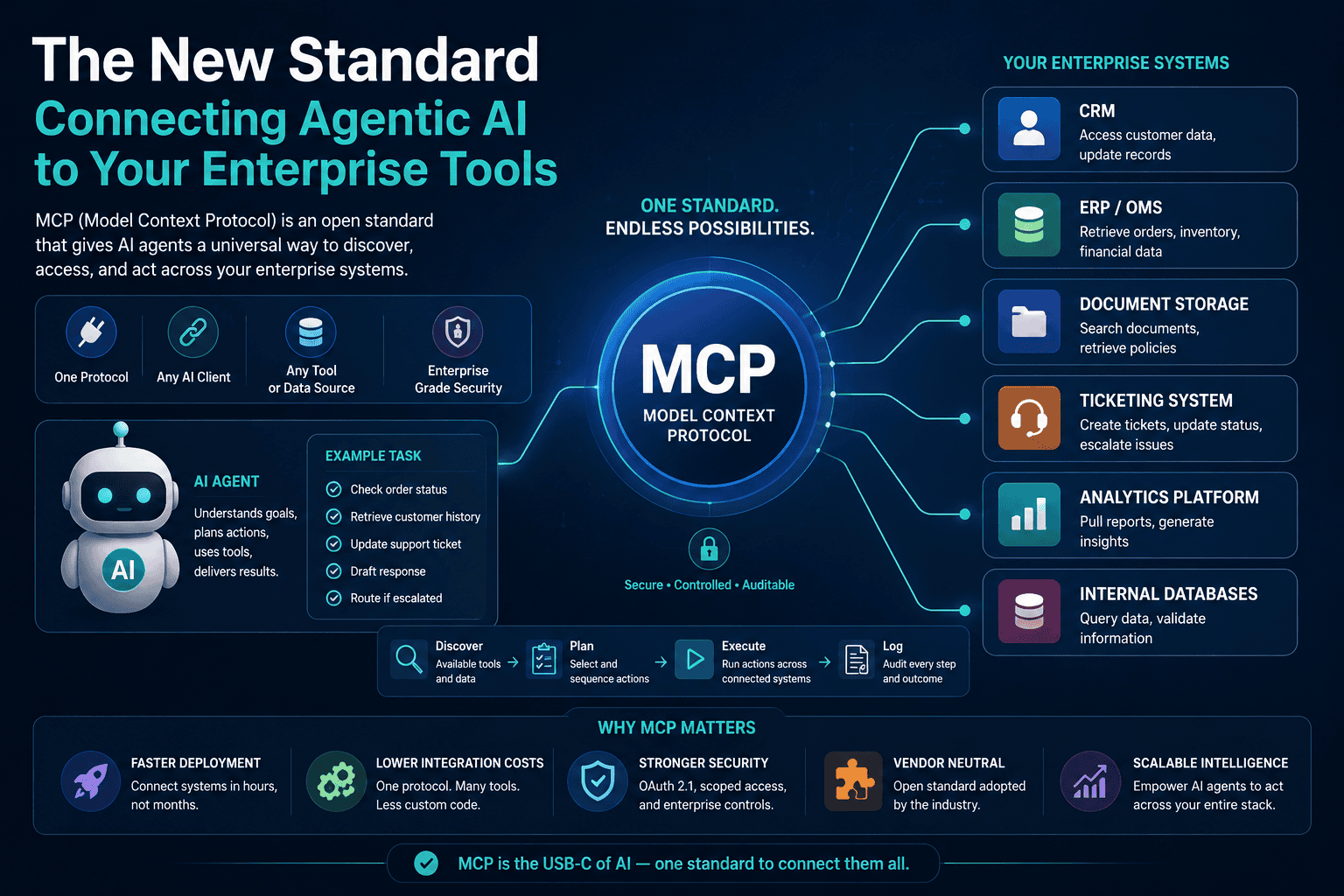
MCP is an open standard originally introduced by Anthropic in November 2024 that gives AI agents a universal, consistent way to discover and interact with external tools, data sources, and services. Think of it as a common language that any AI agent can speak, and that any enterprise system can be configured to understand.
Before MCP, every connection between an AI agent and a business tool was bespoke. After MCP, a single protocol handles the relationship. Any MCP-compliant AI client can connect to any MCP-compliant server regardless of which AI vendor built the model, and regardless of which software company built the tool.
It’s been described as the USB-C of artificial intelligence. One standard. Plug in anything.
The protocol was adopted by OpenAI in March 2025, Google DeepMind in April 2025, and by December 2025, Anthropic donated MCP to the Agentic AI Foundation under the Linux Foundation a directed fund co-founded with Block, OpenAI, Google, Microsoft, AWS, Cloudflare, and Bloomberg. That donation made MCP vendor-neutral infrastructure, governed by the open-source community rather than any single company.
For enterprise leaders, that governance structure matters. It means MCP isn’t a bet on one vendor’s roadmap. It’s a bet on a standard the same kind of foundational bet enterprises made on HTTP, on REST APIs, on OAuth.
How MCP Actually Works: A Business-First Walkthrough
The technical architecture behind MCP is worth understanding at a conceptual level, because it shapes how you think about deploying agentic AI across your organization.
The protocol has two sides. There’s the MCP client the AI agent that wants to do something. And there’s the MCP server the system that exposes data or actions the agent can use. Your CRM becomes an MCP server. Your document storage becomes an MCP server. Your ticketing system, your database, your internal knowledge base all of them can be configured to speak MCP.
When an agent receives a task, it queries the available MCP servers to understand what tools and data are accessible. It discovers, for example, that it can get_customer_record, update_ticket_status, or generate_summary_report — meaningful descriptions of real actions. It then selects and sequences the right tools to complete the goal, executes them in order, and logs every step.
Here’s what that looks like in a real business scenario.
A customer contacts your support team about a delayed order. An agentic AI system picks up the query. Through MCP connections, it retrieves the order details from your OMS, checks the current delivery status from your logistics integration, looks up the customer’s account history in your CRM, and drafts a response all before a human agent has opened the ticket. If escalation is needed, it routes accordingly and creates a summary for the agent who picks it up.
That entire sequence runs through MCP. No bespoke code stitching the tools together. No fragile webhook chain that breaks when one system updates. One protocol, multiple systems, coordinated action.
The Security Architecture That Makes This Enterprise-Ready
One of the reasonable concerns about giving AI agents access to enterprise systems is permission scope. The worry: an agent with access to your CRM might do more than it’s supposed to. An agent connected to your financial data might access records it doesn’t need for a given task.
MCP addresses this through a few key design decisions.
Authentication follows the OAuth 2.1 standard the same enterprise-grade protocol used across modern SaaS platforms. IT and security teams work with familiar controls, and MCP server access can be managed through the same identity provider that governs everything else.
More importantly, MCP supports session-scoped authorization. Rather than granting agents persistent, open-ended access to systems, access is tied to the duration of a specific task. When the session ends, access ends. The agent cannot renew on its own. A human must explicitly approve a new session. This keeps agents operating within well-defined boundaries, and limits the blast radius if something goes wrong.
The principle of least privilege also applies: each tool call grants only the minimum permissions required for that specific action. An agent retrieving a customer name doesn’t get write access to the entire account record.
For enterprise security teams, this architecture makes MCP-powered agentic AI meaningfully different from earlier, less-governed automation approaches. It’s not a general-purpose key to your systems it’s a structured, audited, session-controlled protocol with enterprise identity at its core.
Where Agentic AI and MCP Are Already Creating Business Value
The combination of autonomous AI systems and MCP-based connectivity isn’t theoretical. Across industries, early deployments are showing what’s possible when intelligent agents can finally reach the systems they need.
Human Resources and People Operations
HR teams are among the early beneficiaries. An agentic AI connected via MCP to an HRMS, payroll system, and internal policy repository can handle routine employee queries autonomously leave balances, reimbursement status, policy clarifications while routing edge cases to the right human. The agent doesn’t just answer questions; it retrieves live data, updates records where permitted, and closes the loop without requiring HR staff to be in the middle of every interaction.
Onboarding workflows see similar benefits. A new employee’s provisioning sequence accounts, equipment requests, policy acknowledgements, orientation scheduling can be orchestrated by an agent that coordinates across IT, HR, and facilities systems through MCP, rather than requiring manual handoffs between departments.
Financial Services and FinTech
In financial services, the combination of agentic AI and structured data access is especially powerful. A loan processing agent connected to credit bureaus, KYC validation systems, and internal underwriting rules via MCP can retrieve, cross-check, and analyze the inputs needed for a credit decision in minutes rather than days.
Compliance monitoring becomes continuous rather than periodic. An agent that can access transaction data, regulatory rule databases, and audit logs through MCP can flag anomalies and generate reports without a scheduled review cycle. The protocol’s built-in audit trail every tool call, every data access, every action is a natural fit for the documentation requirements in regulated industries.
Customer Experience and Support Operations
Support operations are arguably where agentic AI and MCP create the most immediate ROI. When an AI agent can read a CRM record, check an order status, access a knowledge base, and update a ticket all in a single, governed session the resolution path collapses dramatically.
The contrast with scripted chatbots is significant. A scripted bot follows a decision tree and escalates when it hits an edge case. An agentic AI system reasons through the goal, accesses real data, adapts to what it finds, and resolves or escalates based on actual context. MCP is what gives it the reach to do that across the tools your support team actually uses.
Sales and Marketing Workflows
Sales workflows involve a lot of system-hopping: checking CRM records, pulling enrichment data, scheduling meetings, drafting outreach, logging calls. These are high-frequency, high-value tasks that collectively consume significant SDR and AE time.
An agentic AI system connected via MCP to your CRM, calendar, email, and enrichment tools can handle the coordination layer pulling context, personalizing outreach, scheduling follow-ups so your sales team focuses on the conversations that actually need human judgment.
MCP vs. Traditional Integrations: What’s Actually Different
If your organization already has API integrations or RPA deployments, it’s worth being precise about how MCP changes the equation rather than treating it as yet another integration layer to manage.
Traditional REST APIs are point-to-point and static. You define an endpoint, you write code to call it, you handle authentication separately, and you maintain that connector independently from every other connector. It works, but it doesn’t scale gracefully as your agentic AI footprint grows.
MCP is dynamic and discoverable. An agent can query an MCP server to learn what tools and data it exposes, without anyone writing new integration code for each new use case. The protocol also creates a shared context model the server communicates not just what it can do, but the shape and meaning of what it returns, so the AI agent can reason about it intelligently.
RPA, by comparison, automates fixed sequences by mimicking user actions at the interface level. It’s brittle by design a UI update can break an RPA workflow, and the process must be re-mapped. Agentic AI working through MCP is goal-oriented: it receives an objective, reasons through the required steps, and adapts when conditions change. For most enterprises, MCP-connected agents are where new automation investment makes more sense than extending RPA footprints.
That said, MCP doesn’t replace existing APIs or eliminate RPA overnight. It provides an intelligent routing and context layer on top of existing systems, gradually making the underlying integration complexity invisible to the AI agent and to the business teams deploying it.
The AI Code Advantage: Making MCP Accessible Without an Engineering Team
One of the most significant shifts MCP enables is democratization. Historically, connecting AI systems to enterprise tools required specialized backend development understanding authentication flows, writing connector code, managing server infrastructure. That meant enterprise AI deployments depended on engineering bandwidth, which is almost always constrained.
AI code platforms change this dynamic substantially. When an automation platform is built around MCP-compliant architecture, business teams HR managers, marketing operations leads, customer success teams can configure agentic AI connections through visual interfaces, without writing the underlying protocol code.
This matters because the teams closest to the problems are rarely the ones with the most development resources. A customer success operations team that wants to connect an AI agent to their CRM, their ticketing system, and their knowledge base shouldn’t need to open a development sprint to do it.
Platforms like Kriatix are designed around exactly this model: the protocol complexity sits in the infrastructure layer, and the configuration sits in the hands of the people who know the business processes best. The result is faster deployment, faster iteration, and AI automation that scales with the business rather than with the engineering team’s capacity.
What MCP Doesn’t Solve Yet The Honest Picture
Credible evaluation of any emerging standard means acknowledging its gaps, and MCP has them.
- Audit infrastructure is still being built by each deployment team independently. The protocol doesn’t yet define a standardized audit trail organizations running production MCP deployments are creating their own logging and compliance monitoring. This is one of the more significant gaps for enterprises in regulated industries, and it’s an active area of development in the 2026 protocol roadmap.
- Multi-tenancy isn’t addressed at the protocol level. SaaS vendors building MCP servers for enterprise customers need to handle tenant data isolation themselves, outside of what MCP specifies.
- Security risks are real, even with the OAuth 2.1 foundation. Security researchers have identified prompt injection risks where malicious content in a connected data source could influence agent behavior as well as risks from over-permissioned tool access and lookalike MCP servers impersonating trusted ones. These aren’t reasons to avoid MCP; they’re reasons to deploy it with governance structures in place.
For enterprise teams, the practical implication is this: MCP is production-ready for well-scoped, governed deployments. It is not a plug-and-play solution that handles all security and compliance considerations automatically. Your existing AI governance framework needs to be updated to include MCP-specific controls, and most frameworks written before late 2025 don’t yet reflect that.
Procurement Questions Every Enterprise Should Now Be Asking
Because MCP has become the de facto standard for agentic AI connectivity, it’s now a meaningful evaluation criterion when assessing AI platforms, automation tools, and enterprise software vendors.
The question has shifted from “will there be a standard?” to “is this vendor compliant with it?”
Before you invest in any agentic AI platform in 2026, these are the questions worth asking:
- Is the platform MCP-compliant, and against which version of the specification? “We support MCP” without a version is not a useful answer the specification has versioned releases and capabilities vary.
- Does the platform act as an MCP client, a server, or both? The distinction matters for how it fits into your architecture. A client consumes tools from servers. A server exposes tools to clients.
- What MCP servers does it ship with natively? Off-the-shelf connectors to your existing enterprise systems dramatically reduce deployment time.
- How does it handle session-scoped authorization and audit logging? These are the governance details that determine whether a deployment is enterprise-grade or a proof of concept.
- What’s the migration path if you switch AI models? If the platform is built on MCP, the integrations should be portable the model is substitutable without rebuilding the connection layer.
What Comes Next: The Agentic AI Infrastructure Layer Is Taking Shape
MCP is one piece of a larger protocol ecosystem that’s forming around agentic AI. The Agent-to-Agent (A2A) protocol developed by Google and supported by a growing list of vendors addresses how multiple AI agents coordinate with each other, rather than how agents connect to tools. These two standards are complementary: MCP handles the connection between agents and enterprise systems; A2A handles the coordination between agents themselves.
Together, they point toward a world where multi-agent orchestration networks of specialized AI agents working in parallel across complex enterprise workflows becomes architecturally feasible at scale. An orchestrating agent coordinates specialist sub-agents; each sub-agent connects to relevant enterprise systems via MCP; the results flow back through a governed pipeline with audit trails at every step.
That’s not a distant vision. It’s the direction enterprise architecture is actively moving in 2026, and organizations building their agentic AI foundations now are doing so on a protocol layer that’s already in place.
The Strategic Takeaway
MCP represents something enterprises haven’t had in AI before: a stable, vendor-neutral connectivity standard that doesn’t lock you into a single model, a single platform, or a single integration approach.
For agentic AI to deliver real business value, it needs to reach the systems where your data lives and your work gets done. MCP is how it does that. Not through custom middleware, not through brittle point-to-point connections, but through a shared protocol that’s already been adopted by every major AI provider and is now governed by the open-source community.
The enterprises that treat MCP as an architectural decision building their agentic AI deployments around it from the start will find they’ve invested in infrastructure that compounds. Every new MCP-compliant system they connect extends the reach of every agent they’ve deployed. Every new AI capability that follows the standard integrates into the existing fabric rather than requiring a new integration project.
The integration bottleneck that held enterprise AI back is being dismantled. MCP is what’s replacing it.
Ready to Connect Your Agents to the Systems That Matter?
Kriatix is built for teams that need agentic AI to work inside their existing enterprise environment not alongside it. With MCP-aligned architecture and a low-code platform that puts agent configuration in the hands of business teams, you can deploy intelligent automation across your tech stack without building the integration layer from scratch.
Book a Demo to see how Kriatix connects agentic AI to your enterprise tools and start closing the gap between your AI’s potential and what it can actually do.